Author: Lachlan Bush Date Posted:21 October 2020
You've just broken into the gigging scene after lots of practice and tryouts. That big gig is coming up so you decide to change your strings. You start your first song but something is wrong... The guitar is already out of tune! But how? Is the guitar low quality? Maybe the new strings are bad?
You tune it again. halfway through the next song, it's out AGAIN? What is going on?
Maybe something went wrong with that new set-up.
Does this story sound familiar? Check out these tips to fix up your tuning issues, for good.
Number one on our list is tuning up. Of course, you've heard the phrase "tuning up" your guitar before, but did you know it's because Tuning down is bad?
Let me explain. When you tune up to a note, the string is being pulled by the machine head, with the string, the bridge, the headstock, and machine heads all being under equal pressure.
When you tune down to the note, there are a few problems that go on.
How do you solve this? Easy! Always tune up to pitch, no matter what.
Let's say you want to go to Drop D tuning from E Standard, you need to
Whenever you stretch your strings, you force the string to equalize the tension across the length of the string, resulting in stable tuning as everything is equal. As you can see above with regards to tuning up, string tension being equal is the secret for stable tuning.
Ok, but how do I stretch my strings?
Simple! Put your finger underneath the string and pull it up! it shouldn't hurt, but give it a bit of a pull so that it gets a bit more tension on it than it would from normal playing. In doing this you stretch it all out to be equal. This will result in the tuning of the strings going down, so be sure to retune again after doing this!
The machine heads are a really likely source of tuning stability issues. Usually, this is due to the number of turns you have on the string posts on the machine heads. Ideally, you want no more than 3 turns on the post when the guitar is tuned to pitch, with standard machine heads. Locking tuners do not require this many turns on the post.
If you have more than 3-4 turns, there won't be enough room for the string on the post, meaning the turns can slacken, grip, have incorrect tension, and jostle for position. All of this results in poor tuning stability.
if you have less than 3-4 turns, there won't be enough string to grip! This can result in the string slipping through the machine head, causing it to go out of tune.
How do you avoid this issue?
Make sure that when changing your strings, you measure 3-5cm past the machine head before cutting. this will make sure you have enough turns on the string post!
Another problem is gaps between the strings on the machine head. It's really easy to resolve this! All you need to do, is when you change your strings, press down on the string between the nut and machine head, so that the string has downwards pressure and will wind on tightly, whilst tuning up.
This tip is strictly for acoustic steel-string guitars.
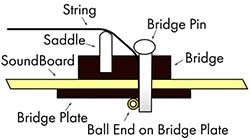
When you install your new strings, make sure you bend the ball end of the string so that it goes underneath the soundboard. This graphic demonstrates how it needs to sit. If you install the strings correctly, the bridge pins should have nearly no tension on them. The benefit of this is that the string is now connected much more solidly to the body, and you'll have even better tone and sustain.
I hope this guide helped you to get your tuning sorted. I recommend looking at our videos below for further help.
Check out our videos to help you keep your guitar in tune!
Thanks for reading this blog! to give you even more great content, check out our pages.
Join our newsletter for tips, advice, new products, and great deals
Visit our YouTube channel for some great Demo’s & Tutorials
Our Facebook page for updates and specials and more
I hope this article has helped. if you need any assistance please email:
sales@artistguitars.com.au or call us on 1300 489 816
© Artist Guitars 2022


We started Artist Guitars with a simple belief: quality instruments shouldn't cost the earth. By working directly with our manufacturing partners and selling straight to you, we skip the traditional retail markups that inflate prices. Need expert advice? We’ve got you covered. Our team of musicians is here to help you find exactly what you're looking for.

Read what the Artist Community have to say.
Need more info? You can find it here.
In stock products are dispatched from our warehouse in Yennora, NSW (close to Fairfield) within one business day of purchase. To get an estimate for shipping to your post code please use the Shipping Time Estimator on the product listing.
Drop us an email with your order number and a short explanation for why you'd like to return your purchase. We'll organise a return label for you to print and attach to the box then either drop into your local post office or we can arrange a courier collection if necessary.
If your item arrives damaged we have you covered! Just contact our Customer Happiness team at sales@artistguitars.com.au and we'll arrange a return and replacement for you as soon as possible.
All orders placed on our Australian website are dispatched directly from our local warehouse in Yennora, Sydney (NSW). This ensures fast, reliable delivery right across Australia.
You should receive an order confirmation shortly after you've placed your order. If you haven't received one, please contact us at sales@artistguitars.com.au and we'll look into it for you.
We sell direct to consumer! This helps us keep the cost of our products as low as possible and we pass those savings into our customers which is why our guitars are unbeatable value.

 New Zealand
 United Kingdom